
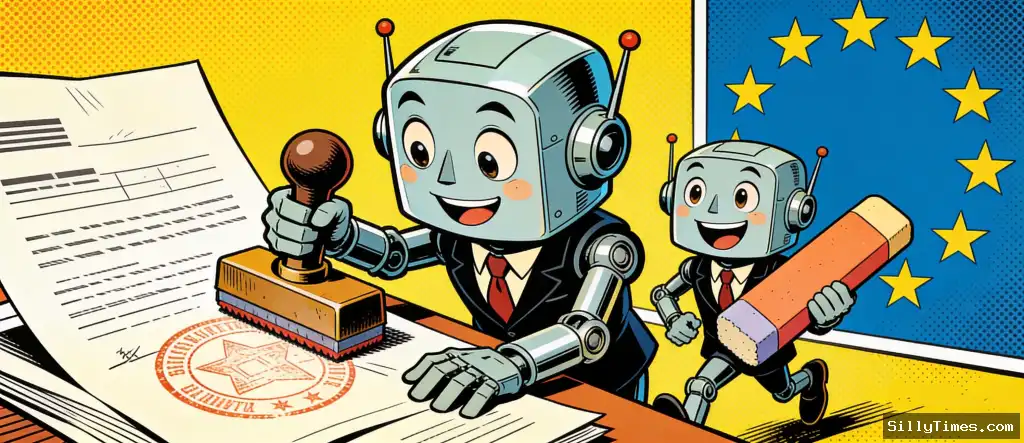
The European Union, never one to shy away from regulating things it doesn’t fully understand, recently decided that AI-generated text must carry a watermark — a kind of invisible digital tattoo that screams ‘a robot wrote this!’ The EU AI Act specifically mandates that AI outputs be ‘detectable as artificially generated’ and embedded in a way that is ‘difficult to separate from the content.’
Difficult! Bold word choice, Brussels.
Software engineer Sean Goedecke has rather politely pointed out the flaw in this grand plan, and that flaw is… another AI. As it turns out, if you want to scrub an AI watermark from a piece of AI-generated text, you can simply ask a different AI to rewrite it. The watermark evaporates like regulatory optimism on a Monday morning. The second AI, blissfully unaware that it’s participating in a scheme to undermine EU legislation, will happily oblige and produce a fresh, watermark-free piece of text that is functionally identical to the original.
The core problem, as Goedecke explains, is that text watermarks work by subtly tweaking word choices and sentence structures during generation. But unlike an image watermark — where you can at least see the ‘Getty Images’ stamped across the giraffe — text watermarks leave no visible trace that a human can verify. They rely entirely on the cooperation of the AI ecosystem to remain intact. And AI, as a collective entity, is not particularly cooperative with regulatory frameworks.
It’s a bit like passing a law that counterfeit banknotes must include a secret marking, and then announcing that marking to the public.
The EU’s intentions are genuinely noble — they want people to know when they’re reading machine-generated content, which is a completely reasonable thing to want. Unfortunately, the technical reality is playing by entirely different rules. Goedecke’s analysis suggests that robust, tamper-proof AI text watermarking may simply not be achievable with current approaches.
So the race continues: regulators sprint to catch up with technology, and technology, wearing noise-canceling headphones, doesn’t notice.
Source: Sean Goedecke’s analysis at seangoedecke.com
Original story via Boing Boing