
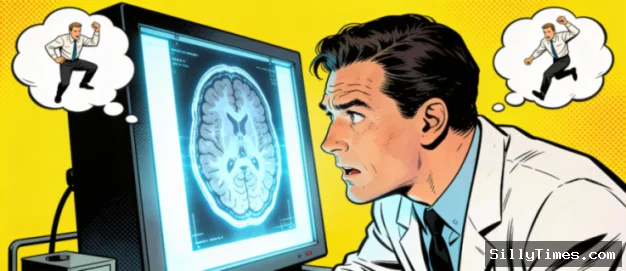
Science has done it again, delivering findings that are simultaneously unsurprising and absolutely fascinating. Researchers at Spain’s University of Zaragoza have published a study in *Neuroscience* that scanned the brains of 100 young adults and discovered something that will shock absolutely no one who has ever argued with a person who really, really loves rules — as long as they’re the ones making them.
The study found genuine structural differences in the brains of people who hold authoritarian beliefs. And before anyone starts feeling smug about which side of the political aisle this applies to, buckle up: the findings covered authoritarians across the spectrum, both left-wing and right-wing varieties.
Right-wing authoritarians, specifically, showed lower grey matter volume in the dorsomedial prefrontal cortex — a region of the brain involved in understanding other people’s thoughts and perspectives. In plain English: the part of your brain responsible for thinking “hmm, I wonder how someone else might feel about this” appears to be running a bit lean in folks who tend toward rigid, hierarchical, comply-or-else thinking.
Left-wing authoritarians, not to be left out of the neurological party, showed their own structural quirks in regions associated with social reasoning and empathy processing.
Now, the researchers are being appropriately cautious — as scientists tend to be when their findings are this politically spicy. Correlation is not causation, and nobody is suggesting we start administering MRIs at polling stations. Brain structure is shaped by genetics, environment, experience, and roughly ten thousand other factors science is still sorting out.
Still, it’s hard not to marvel at the poetic tidiness of it all. The universal complaint about authoritarians — “they just don’t seem to *get* other people” — may have a surprisingly literal neurological footnote.
The rest of us, meanwhile, can sit here with our allegedly average-sized prefrontal cortices, fully unable to decide whether this information makes us feel vindicated or deeply unsettled. Probably both.
*Source: Boing Boing / Futurism, reporting on a study published in Neuroscience by researchers at the University of Zaragoza, Spain.*
Original story via Boing Boing